Sunday, August 3, 2014

One of Reacher's best

Personal: A Jack Reacher Novel
by Lee Child
Random House Publishing Group - Bantam Dell


The Reacher series is the best out there for readers who enjoy contemporary, realistic suspense fiction.  This book may be the best in the series. And this review will fail to communicate just how good a read it is.

What's different about this book
If the reader isn't familiar with the Jack Reacher persona, this story (19th in the series) will be a great introduction.  If the reader has read all of the Reacher novels (or only some), this will be a great follow-up.  The story line and character development extend our understanding of who Reacher is and how he rolls.  It makes for such a great, fun read!  By the end of the book, we are more aware than ever of just how smart he is, how strategically he understands situations and people, and how fun it is to read this series.  There are many series where, by #19, we are left wanting more.

What I'll do now that I've read it
For libraries where I influence purchases, and for my friends who savor an engaging read, copies will be made available.  I am excited to be able to share this with my friends and patrons, both those who already know Reacher and Lee Childs, and those who have yet to experience the pleasure.  


* * * * * * * * * * * * * * * * * *


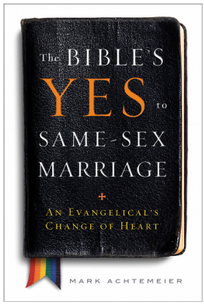
The Bible's Yes to Same-Sex Marriage
by Mark Achtemeier
Publisher Westminster John Knox Press

June 2014

I share the author's concern about broad-spread hostility towards others.  As he articulates, we all bear the fallenness of sin.  We do so first because we are sinful and then because we live sinfully.  I hoped for a true Biblical response that would provide fresh avenues of grace for us to live in shalom

Instead, the author presents personal stories of hostility and bias in the lives of practicing homosexuals.  He demonstrates significant empathy and compassion for those individuals.  The author also presents the classic Biblical injunctions against homosexuality but avoids Biblical exposition that would argue against the traditional stance.  Ultimately, for the author, the book's argument holds human reason as superior to Biblical truth.

What's different about this book
All sinners face the problem of their individuality being conflated with the evil of their sin.  The author writes with clear compassion shown for those affected by judgment and hostility against the sinner, when our focus should be on the sin -- in a spirit of love for the individual.

What I'll do now that I've read it
I remind myself that the appearance of words such as evangelical and Bible and heart do not themselves signify a powerful or Godly message:  It is still the content in the message that counts.  And once again, we readers are told that our own logic and reasoning should be the authority by which we seek to offset generations and centuries of hostility confusing the sinner with the sin.  Unfortunately, nothing new here.

* * * * * * * * * * * * * * * * * *
Wednesday, July 9, 2014

Gabriel Finley and the Raven's Riddle: A perfect adventure for middle-grade readers

Gabriel Finley and the Raven's Riddle
by George Hagen; illustrated by Scott Bakal
Random House Children's / Schwartz & Wade
October 2014


I loved this book:  Quick to engage the reader, a plausible and compelling adventure, and a somehow comforting and safe environment in which young Gabriel can encounter all sorts of bad guys and dangerous situations and still come out the victor.

What's different about this book
It's wholesome. Elegantly so. I find it hard to describe, but this is the most secure background I've read for a story that included bad magic and life-threatening adversaries.  Somehow the warm family settings confirm what the reader quickly realizes: the author has Gabriel's best at heart.  (Even the one not-good home setting of the story is resolved in a positive and healing way.)  I mean, how often do you read stories where twelve-year-old kids walk the streets of Brooklyn at night, and the only sense of peril is from the magical challenge they are heading to?  I loved it -- and I loved the absence of real-life social ills and threats that are too often present in similar "adventures."

What I'll do now that I've read the book
My libraries will be buying this book, and I'll have so much fun book-talking this to readers who should be quickly won over to a book that is adventurous and challenging -- and full of riddles middle-graders can understand and enjoy! Well done, Mr. Hagen.  Reading this was a pleasure.

 * * * * * * * * * * * * * * * * *

The Vault of Dreamers -- an engaging near-future science fiction for young adults

The Vault of Dreamers
by Caragh M. O'Brien
Macmillan Children's Publishing Group
September 2014


This young adult near-future science fiction novel has a great plot:  Some of the best art students from around the nation come to study at the prestigious school, The Forge.  And they are living that dream, while living in a reality show.  To survive and keep their prestigious enrollment, the students have to keep their viewer ratings high in order to stay at the school. Of course, the protagonist Rosie is a non-conformist and can't follow the rules -- which leads to an interesting plot line.

What's different about this book
Although set some thirty or forty years in the future, the world Rosie lives in could be our near future -- except for some technologies and scientific/medical capabilities that don't yet exist.  The reader who doesn't usually like science fiction will be able to feel comfortable in this milieu. The themes are enduring, of course, but with a nice contemporary (and beyond) twist. The relationships develop realistically among the characters, but the pressure and suspense just keep on growing -- and the author doesn't provide any easy solutions.  Which causes the main objection I have for this book: a strongly unsatisfying denouement and an ending not warranted by the author's construction of the story.  The narrative didn't prepare me for what felt like an "oh, well" conclusion.

What I'll do now that I've read the book
The book is an engaging and enjoyable enough read that I will promote this for my high school libraries.  I think it will catch some reluctant readers, as well as more mature consumers of science fiction.  But I won't have my heart in the recommendations when I book talk to students -- somehow the crafting of the book just didn't come to a natural full circle for me.


* * * * * * * * * * * * * * * * * * *

Wednesday, February 12, 2014

New old folk tales

The Little Moose Who Couldn't Go to Sleep
A Maynard Moose Tale
Willy Claflin, James Stimson
August House / LittleFolk
January 2014


Reading a digital ARC just doesn't do this book justice.  The story line and rhythmic language and folksy moose speak (as interpreted in modern English) are grand, but the wonder of the illustrations is diminished by the cross-screen portions that the ARC on a device delivers.

What's different about this book:
I am drawn to the modern-day old folksy touch, and I particularly like the legend-building narrative about Mother Moose and her kitchen where she creates all things.  I think the illustrations accompanying the story (if seen side by side) would really enhance the text of Little Moose who can't get to sleep.  I think little ones will identify readily with Little Moose whose brain is just sooo busy. And readers of all ages will enjoy the gentle humor that leaks around the edges of the story lines.

What I'll do now that I've read it:
I have not paid attention to the Maynard Moose series before now, and I like the feel and the looks of this latest release.  My libraries will be adding this series to their consideration pages -- great stuff for both libraries and homes.


* * * * * * * * * * * * * * * * * *

Monday, February 10, 2014

A satisfying one-sitting read

The Statistical Probability of Love at First Sight
Jennifer E. Smith
Little, Brown Books for Young Readers

January 2012

The publisher's offer of a free re-visit of this book gave me a great reason to sit and savor a great story.  My young adult readers have told me how good this book is, and now I can agree:  it's a genuine look at teen problems, family relations, and instant attraction.

What's different about this book:
Sometimes I just want to enjoy a sweet romance with the drama occurring somewhere other than in the relationship.  This book provides that, with enough other issues to make it real.  And what some reviewers have called a predictable ending, I call satisfying.  I seldom read a book all in one sitting, but this one I did.

What I'll do now that I've read the book:
We are enjoying all the Jennifer Smith books we already own and looking forward to The Geography of You and Me, coming this April 15.  Oh, and I'll go back and visit Smith's This Is What Happy Looks Like in the meantime. Thanks, LBBforYR!


* * * * * * * * * * * * * * * * * *

Sunday, February 9, 2014

Non-offensive theology

The Answer to Bad Religion Is Not No Religion: A Guide to Good Religion for Seekers, Skeptics, and Believers
by Martin Thielen
Westminster John Knox Press
Feb 2014  


What does Thielen's conversation add to conventional wisdom?  A great group of stories that will touch readers who have probably experienced similar situations.  What the book does not add is light for thinkers, seekers, those who are suffering, and the desperate.

Thielen talks a lot about characteristics of bad religion, of no religion, and of good religion.  He speaks of "the kind of religion that turns many people away." What he leaves out is a recognition that true Christian faith can and does offend many (Romans 9:33).  The book also leaves out an understanding of a powerful Creator who provides steadfast grounding for belief and practice.  Ultimately Thielen's ultimate good is utilitarianism and reason. 

What's different about this book:
 Answer provides a good discussion of the United Methodist denomination's virtues and values.  The part about the Wesleyan Quadrilateral shares that denomination's "four sources of theological authority:" Scripture, tradition, experience, and reason.  Unfortunately the only one of those four authorities that transcends man's human, fallible ability to think and reason is Scripture -- and Thielen eviscerates the Bible as something a person can trust or rely on.

Among the book's argument for good religion is the usefulness that good religion provides.  This brought to mind Screwtape's admonition (in C. S. Lewis' The Screwtape Letters) that Christian belief could easily be destroyed by confusing believers to view "Christianity as a means."

I fall back on the trite but tellingly true concept that Christianity, authentic Christianity, is not a religion but a relationship.  I saw little of a trusting, humble relationship in this writing.

What I'll do now that I've read the book:
I am re-visiting and re-confirming the foundations of my own faith, and I am comparing my understanding of an Almighty and Omnipotent Sovereign.  Not much is said about this Essence in this book, and I conclude that this work is less helpful than others I could purchase and share.


**************************